


Conversion Architecture
Every meaningful action begins with a designed pathway.
People don’t convert because of a button or a page. They move forward when every step feels relevant, trusted, and connected. Cayuse designs the pathways that turn interest into measurable action across the entire digital system.
Diagnostic signal
When
Conversion Becomes Unreliable
Conversion is often treated as something to optimize.
Traffic increases. Campaigns improve. Journeys are refined. But conversion does not follow consistently.
Results fluctuate. Gains do not hold. What works in one context fails in another.
The response is usually more activity. More testing. More UX changes. More iteration.
Conversion is not defined across the system. Intent is disconnected from where users land. Journeys exist, but they do not resolve into clear decisions.
Performance requires constant intervention. Outcomes are difficult to explain. And improvement does not compound.
The issue is not effort. It is structure.
Capability Role
How Conversion Is Structured
This capability defines how conversion happens across the system.
It aligns intent, pathways, and decision points into a single structure.
Rather than improving isolated touchpoints, it ensures that every part of the system contributes to a clear outcome.
Conversion stops being something you try to improve. It becomes something the system is designed to produce.
What It Governs
How intent moves through the system to action
Alignment between acquisition, experience, and destination
Where decisions are made and what triggers them
The structure of conversion pathways across channels
What It Improves
Inconsistent or unexplained conversion performance
Disconnect between traffic and outcomes
Journeys that do not lead to decisions
Reliance on testing without structural change
What It Enables
A clear, repeatable path to conversion
Measurable linkage between activity and outcome
Faster identification of where conversion breaks
Scalable improvement without constant rework
System Function.
How Conversion Holds Up in Reality
Most systems influence conversion. Few actually control it.
Users arrive with intent. But the system does not consistently resolve that intent into action.
Messages do not align with landing points. Pathways fragment. Decision points are unclear or misplaced
Conversion depends on context rather than structure
This capability changes that.
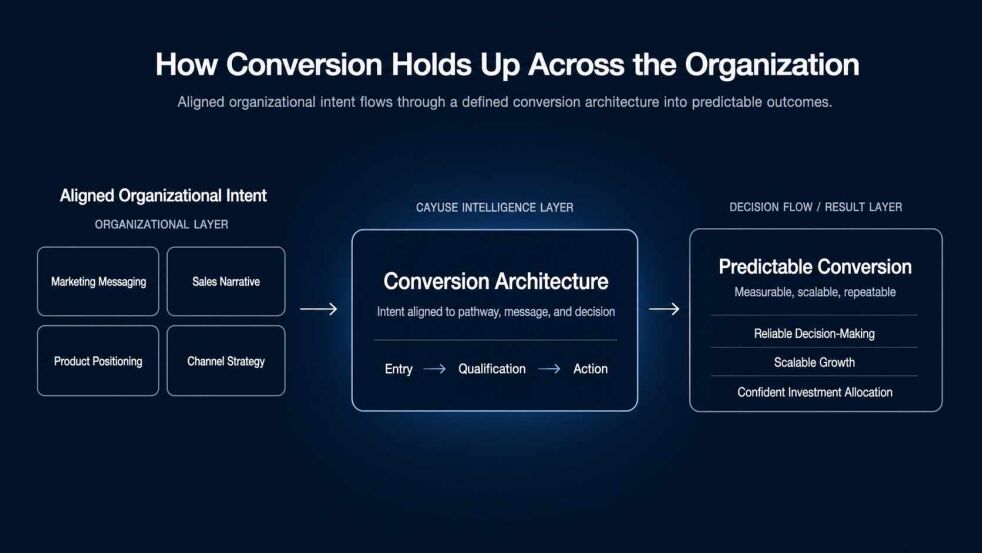
Intent is mapped across the system. Pathways are defined and aligned. Decision points are made explicit and measurable.
The system stops leaking conversion.
The result is not incremental uplift.It is a system where conversion becomes predictable, measurable, and repeatable.
Outcomes.
Predictable Conversion
Conversion becomes consistent across channels and conditions.
Clear Decision Paths
Users move through defined pathways that lead to action.
Performance Under Real Conditions
Faster, more confident decisions based on aligned signals.
Stronger Return on Demand
More value is captured from existing traffic and acquisition.
Compounding Performance
Improvements build over time instead of resetting with each change.



System Illustration
From Unclear Performance to Measurable System Behavior
Organizations often have access to significant data, but limited clarity.
Context
A business was generating strong traffic across multiple channels, but conversion remained inconsistent and difficult to explain.
Different teams were improving different parts of the journey, but no unified conversion structure existed.
What Changed
Conversion pathways were defined across the full organization
Intent was aligned between campaigns, content, and destinations
Decision points were clarified and measured
Fragmented or conflicting journeys were removed
What This Enabled
Conversion became consistent across channels
Performance could be understood and improved directly
Investment produced more reliable outcomes
The system shifted from reactive optimization to controlled performance
A Serious Conversation About Conversion Architecture
If conversion cannot be clearly explained, it cannot be reliably improved.