


CUSTOMER AND USER JOURNEY OPTIMIZATION
Every interaction should make the next decision easier.
Customers experience one journey, even when it crosses different platforms, teams, and channels.
Cayuse aligns those touchpoints so each step builds understanding, strengthens trust, and creates clear momentum toward meaningful action.
CONTEXT.
Customers experience one journey. Continuity is what holds it together.
Pages, channels, forms, and follow-up are often managed separately. When context disappears between them, people repeat themselves, lose confidence, and leave before the journey is complete.
Where continuity is lost
- Context resets between interactions.
- Ownership changes without a clear handoff.
- Messages, actions, and expectations stop reinforcing one another.
- Reporting records activity without showing where intent was lost.
What looks like a conversion problem is often a continuity problem.
When the journey does not hold together, trust weakens, attribution becomes less reliable, and effort is wasted across the system.
Capability Role
How Journey Optimization Functions Within the System
Cayuse’s expertise ensures that users can move clearly and continuously through the system, preserving intent from entry to decision.
It focuses on how journeys actually behave across touchpoints, not how individual pages perform.
Rather than optimizing isolated interactions, it aligns the full journey so each step logically supports the next.
What It Governs
Journey structure across channels and touchpoints
Transitions between awareness, evaluation, and action
Consistency of messaging and interaction logic
Ownership of journey stages across teams
What It Improves
Continuity across the user journey
Completion rates across multi-step experiences
Clarity of progression and decision points
Alignment between user behavior and system intent
What It Enables
End to end journey visibility
Reliable identification of friction points
Coordinated optimization across teams
A system where intent is carried through to completion
CAPABILITY DISTINCTION
Two disciplines. One continuous decision path.
Conversion Architecture defines how intent becomes a decision path. Journey Optimization keeps that path coherent as people move through it.
Conversion Architecture
Defines the path
- Aligns intent, message, proof, and action
- Establishes decision stages
- Designs the route to conversion
Journey Optimization
Keeps the path usable
- Preserves intent through every transition
- Removes friction and broken handoffs
- Maintains continuity to completion
Architecture gives the journey direction. Journey optimization keeps it moving.
System Function.
How Journeys Hold Up in Reality
In most organizations, journeys exist but do not connect.
Users move between pages, channels, and interactions without continuity.
Messaging resets. Steps repeat. Progression becomes unclear.
This capability restructures how journeys are designed and connected.
Pathways are simplified. Transitions are clarified. Each step supports the next.
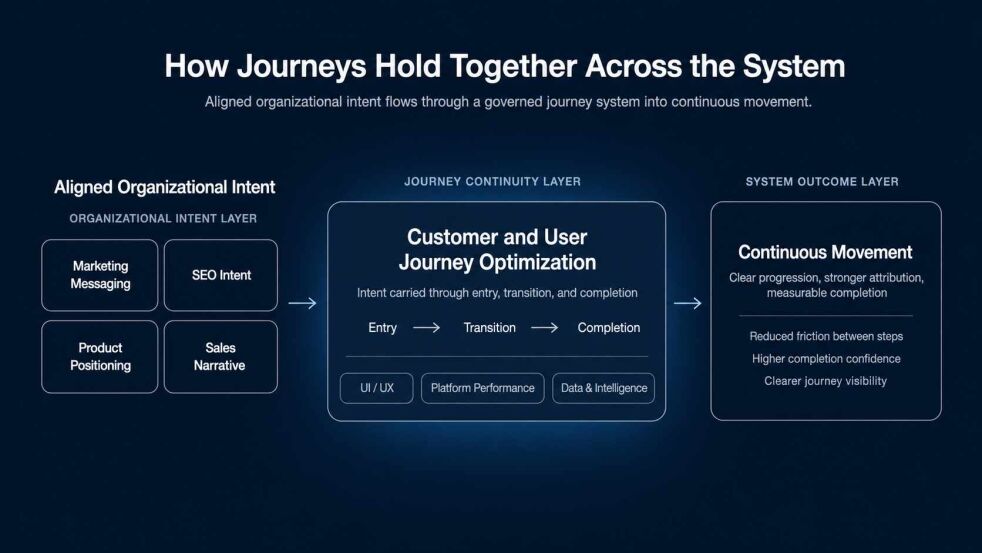
The result is not more activity. It is coherent movement.
A system where users can progress naturally from entry to decision.
Outcomes.
What Becomes Possible When Journeys Hold Together
When journeys are aligned, users move with clarity and intent through the system.
Clear Progression
Users understand where they are and what comes next
Reduced Drop Off
Fewer users abandon journeys due to friction
Stronger Attribution
Performance can be understood across the full journey
Compounding Performance
Improvements build across the system, not isolated pages



System Illustration
From Fragmented Journeys to Continuous Movement
A multi-step journey across marketing pages, forms, and follow-up interactions was underperforming.
Context
Messaging was inconsistent. Steps repeated. Users dropped out before completion.
What Changed
Messaging was aligned across steps
Redundant steps were removed
Progression points were clarified
Journey ownership was defined
What This Enabled
Higher completion rates
Clearer attribution across the journey
Improved coordination between marketing and product
A repeatable, optimizable journey structure

A Serious Conversation About Digital Accountability
If your organization cannot clearly define what performance means, it cannot reliably improve it.
We work with leadership teams to establish systems where data supports real decisions, not just reporting.