

PLATFORM AND SYSTEM PERFORMANCE
A platform should make change easier,
not make every change harder.
Performance is not only about speed or uptime. It is also about whether the platform is stable, understandable, maintainable, and able to support what the organization needs next.
Cayuse evaluates the systems, architecture, integrations, ownership, and operating conditions behind the platform so reliability improves, unnecessary complexity is reduced, and future change remains possible.
CONTEXT.
A platform can keep working while becoming
harder to trust, change, and improve.
Most platform problems do not begin with an obvious failure. Symptoms build gradually as integrations multiply, ownership becomes less clear, releases slow down, and teams become cautious about touching the system.
Work still gets done, but every change requires more effort and carries more uncertainty.
Where platform confidence begins to weaken
- Small changes require disproportionate time, coordination, or specialist knowledge.
- Integrations appear stable, but their dependencies are poorly understood.
- Data, behavior, and reporting vary between tools or environments.
- The platform can be maintained, but no one is confident how safely it can evolve.
What looks like a technical performance problem
is often a platform confidence problem.
When architecture, ownership, and operating knowledge are fragmented, the system may stay online while the organization loses confidence in how safely it can change.
Symptom: Growing technical debt.
Capability Role
How This Capability Functions in the System
This capability defines how your platform performs under real conditions. It governs stability, responsiveness, and the consistency of interaction across environments, devices, and demand levels.
What It Governs
The operating condition of your platform. It ensures stability, responsiveness, and consistent behavior across environments, devices, and demand scenarios.
What It Improves
The speed and reliability of every interaction. It reduces friction, removes variability, and ensures users experience the platform as intended, every time.
What It Enables
Confident growth. It creates the conditions where traffic, complexity, and change can scale without degrading performance or breaking the experience.
System Flow.
How Platform Performance Holds Up in Reality
Performance is not static. It emerges as people interact with the system.
Every visit creates load. Pages respond. Data is captured. Behavior moves forward or breaks down.
When the system holds, signals stay clean and behavior is consistent. You can see what is happening.
When it does not, signals fragment. Performance becomes harder to read. Decisions slow down.
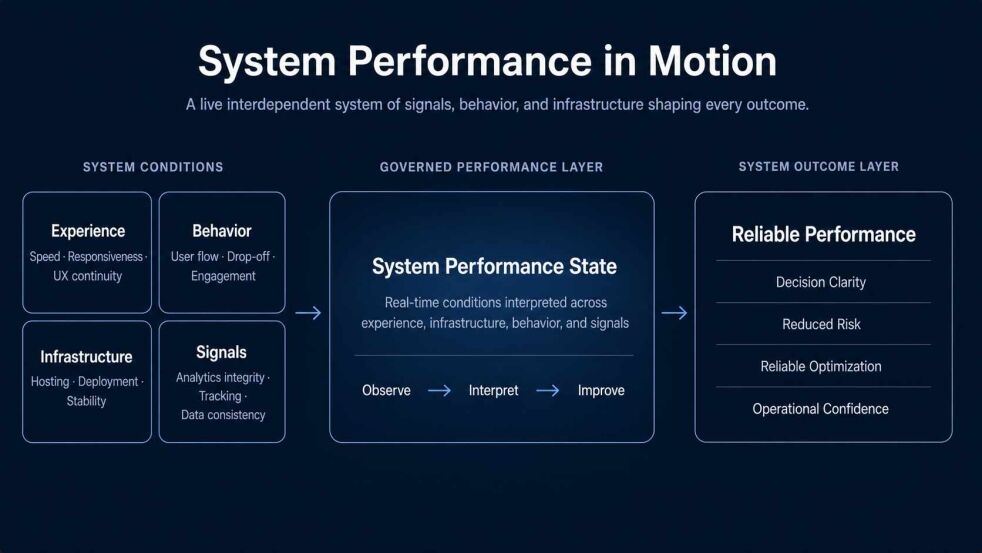
Performance is not what the platform is designed to do. It is what it actually delivers, every time someone uses it.
Outcomes.
What Becomes Possible When Performance Holds
When the system is stable, performance stops being assumed and starts being understood.
Visibility You Can Trust
Data reflects real behavior, so you can see clearly what is happening and why.
Performance Under Real Conditions
The platform responds consistently across devices, environments, and levels of demand.
Decision Clarity
Teams move faster because signals are aligned and dependable.
Compounding Growth
Improvements build over time instead of resetting with every change.



System Illustration
From Unclear Performance to Measurable System Behavior
This example shows what changes when platform stability, measurement, and iteration are brought into alignment.
Context
A digital platform was generating consistent traffic across multiple channels and markets.
Activity was strong, but performance was difficult to interpret. Behavior varied by environment, and measurement was inconsistent.
The issue was not demand. It was the lack of a stable system producing reliable signals.
What Changed
Platform stability was addressed so responses remained consistent under real conditions.
Measurement was aligned across environments to reflect actual user journeys.
Data flows were simplified, removing gaps between systems and channels.
Release processes were structured to maintain integrity as changes were introduced.
What This Enabled
Performance became comparable across channels, markets, and time.
Behavior could be understood without second-guessing the data.
Decisions moved faster because the system could be trusted.
The platform became a stable base for continuous improvement.
A Serious Conversation About Digital Accountability
If performance cannot be trusted, it cannot be improved. We help organizations build systems that produce clear signals, support confident decisions, and scale without hidden instability.